
Sikh boy from Hastings who wants you to look within wins Race Unity Speech Awards
Media Story by Ravi Bajpai, AWAAZ
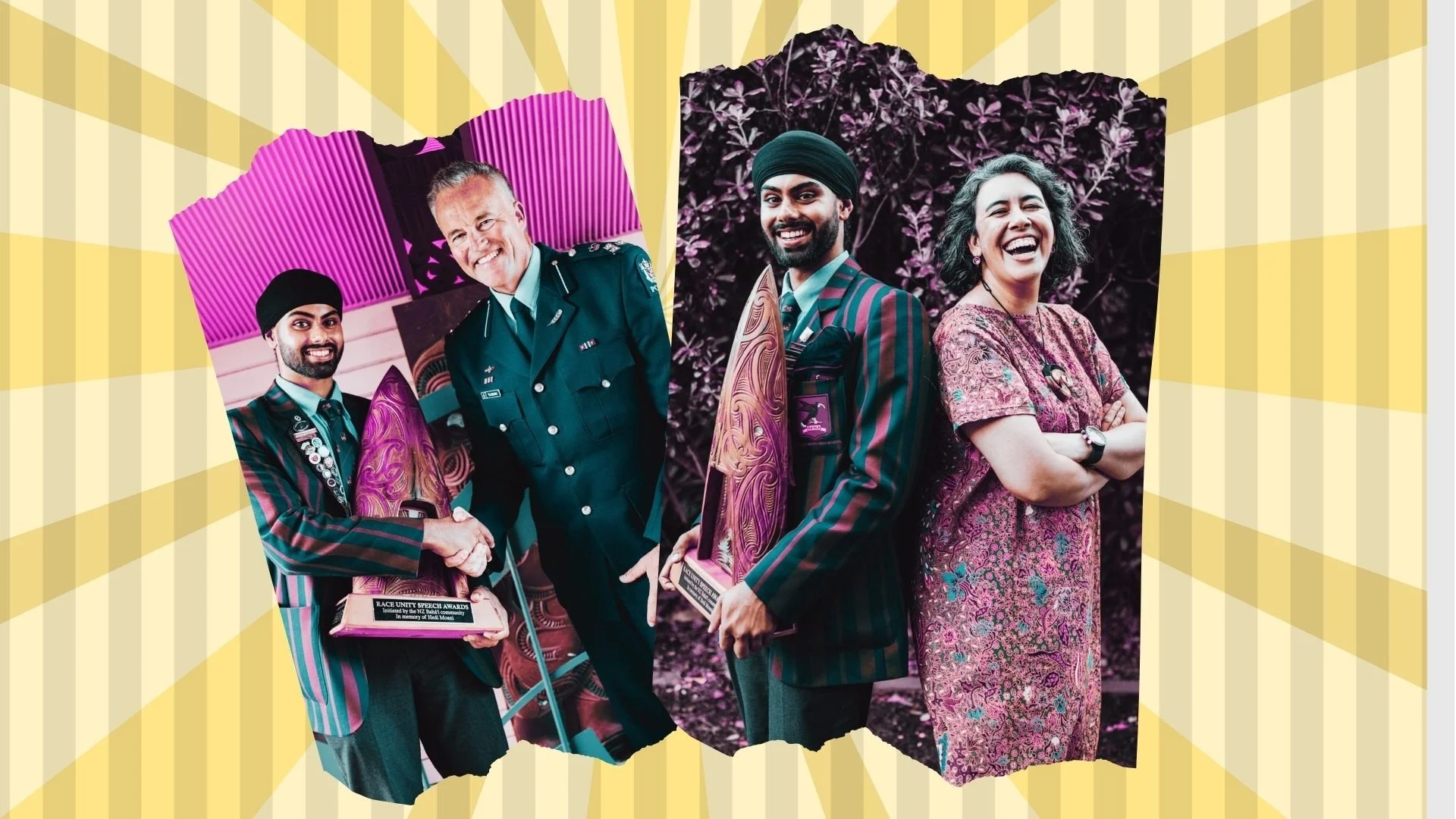
Amanjot with Assistant Commissioner Tim Anderson (left) and Children's Commissioner Dr Claire Achmad. (Supplied photos, Awaaz artwork)
The teenager from North Island took home three awards in the competition designed to explore race relations in New Zealand.
“Yeah it’s really powerful; listening before we speak,” the radio host said.
“Only by truly listening can a message be understood,” replied Amanjot Singh, translating a Punjabi saying that sits at the heart of his thinking.
That exchange on RNZ's Morning Report earlier this week came after the Hastings Boys’ High School student was named the national champion of the 2026 Race Unity Speech Awards.
It was the top honour in a competition designed for senior students to explore how race relations in New Zealand can be strengthened.
The awards are conducted by the New Zealand Bahá’í Community. At least 2,000 secondary school students have participated since the competition began in 2001.
The initiative, which celebrates Race Relations Day on March 21 every year, is supported by New Zealand Police, Human Rights Commission and Ministry for Ethnic Communities among others.
The 18-year-old also collected multiple category awards on the night, including recognition for 'manaakitanga' and vision, placing him among a small group of other winners across individual categories.
The awards span different aspects of speaking. From empathy and delivery to cultural understanding and impact. Singh’s exploits reflect a rare level of consistency across them.
His winning address, The Courtroom of Life, uses a legal metaphor to examine how quickly people form judgments about others, particularly in moments shaped by race and identity.
At its centre is a challenge. That people often “listen like lawyers", preparing rebuttals before they have fully understood what is being said.
The speech draws on Singh’s lived experience growing up Sikh in New Zealand, where identity is often filtered through perception before it is heard on its own terms.
One passage asks audiences to pause and picture everyday figures they might overlook. A taxi driver, a fast-food worker, someone working late at night. Then it asks the listeners what assumptions were made in that instant.
The idea, Singh told RNZ, is that racism is not only found in overt acts, but also in the quieter habits of perception. And that responding to it requires more than reaction. It requires attention.
The RNZ interview also briefly turned to his Punjabi background, where he framed listening not as politeness but as discipline. A way of ensuring meaning is not lost in assumption or speed.
Beyond the speech itself, Singh’s journey to the national title was grounded in family and school support. He spoke about his father’s migration from India, arriving in New Zealand with limited English and navigating early experiences of silence and adaptation.
That experience, Singh suggested, helped shape how he understands identity, not as something fixed, but something formed through struggle and recognition.
He also shared a quieter moment from the competition. His parents, who had unexpectedly attended earlier rounds, waited in a car park while he delivered his speech.
Seeing them after the win, he said, carried a different weight. One of shared effort rather than individual achievement.
“When I was young, my skin was my burden,” Singh said. “Now it’s my blessing.”
Following his win, Race Unity Aotearoa described the speech as “deeply personal and thought-provoking”, highlighting its focus on empathy, identity, and responsibility, and its emphasis on listening to understand.
Hastings Boys’ High School also marked the achievement at a school assembly, celebrating Singh’s national title and his acknowledgement of his teacher and mentor, Mrs Ormsby, whom he credited as central to his development as a speaker.
Tukituki MP Catherine Wedd also congratulated him, calling the result “from regional to national winner” and describing Singh as an inspiration to the Hawke’s Bay community.
For the competition judges, the result reflected not just performance, but breadth – recognition across empathy, vision, and leadership categories alongside the overall title. For Singh, however, the idea remains simpler.
“It’s not much to ask that we listen,” he said.